
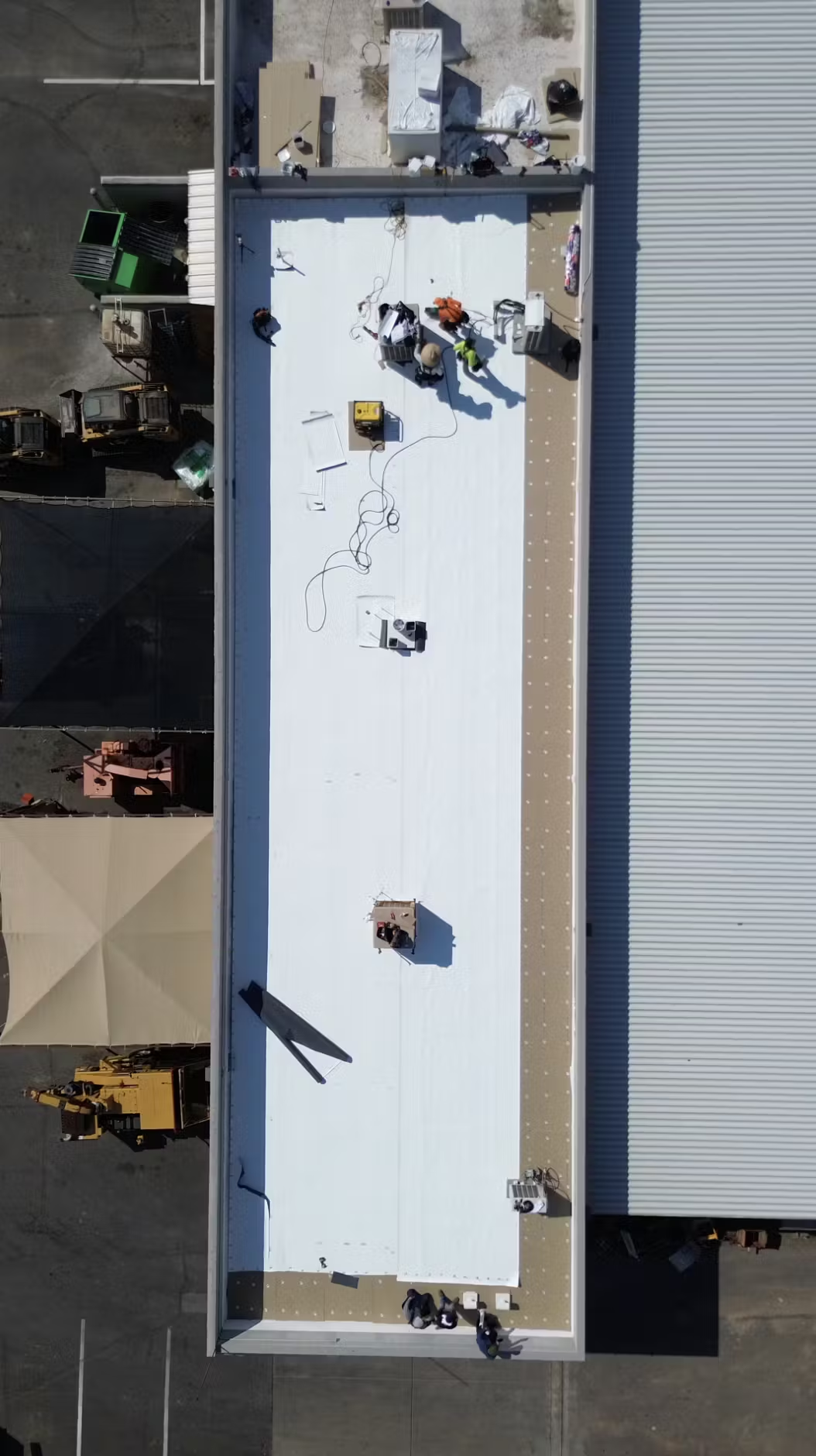

How the main flat roof systems differ
TPO and PVC are thermoplastic single-ply membranes with heat-welded seams. EPDM is a thermoset rubber with taped or adhered seams. Modified bitumen is a multi-layer asphalt-based system. Spray polyurethane foam is sprayed in place and then coated, because the foam itself needs UV protection. Coatings can also be applied over a sound existing roof after inspection. A white cool roof can reduce rooftop heat gain in Arizona, but energy savings are not guaranteed.
| System | What it is | Seams or surface | Arizona notes |
|---|---|---|---|
| TPO | Thermoplastic polyolefin | Heat-welded | Common white cool-roof choice; high-heat formulations exist for elevated rooftop temperatures |
| PVC or PVC-KEE | Thermoplastic PVC, including KEE | Heat-welded | Strong cool-roof whites; recommended around grease, oils, or chemicals |
| EPDM | Thermoset rubber | Taped or adhered | Black is a poor cool-roof choice here; white is a reflective option. Only Carlisle, of these three, publishes a full EPDM line |
| Modified bitumen | Asphalt-based, usually multi-layer | Torched, adhered, or self-adhered | Can later be coated. Polyglass belongs here, not with TPO or PVC |
| Spray foam (SPF) | Sprayed insulation and roof surface | Seamless foam with a coating | The coating is the UV-wear surface; recoating maintains a sound foam roof |
| Coatings | Elastomeric, silicone, or polyurea | Liquid-applied film | Restore reflectivity on sound foam, modified bitumen, or metal |
TPO in Arizona
We install TPO from Duro-Last, GAF, and Carlisle. White TPO is widely CRRC-listed, with heat-welded seams. See our TPO roofing page.
GAF EverGuard TPO is published in 45, 60, and 80 mil and meets ASTM D6878. GAF also makes EverGuard Extreme TPO in 50, 60, 70, and 80 mil, marketed for high-heat and solar applications. Based on published CRRC ratings, GAF describes white Extreme as the TPO with the highest reflectivity, emissivity, and SRI of available TPO membranes. Current GAF tables list white Extreme at 0.83 initial solar reflectance (SRI 104) and standard white EverGuard TPO at 0.76 (SRI 94). Title 24 cool-roof compliance on those tables is limited to eligible white and some Energy Gray products, not standard tan or gray TPO. Carlisle Sure-Weld TPO is published in 45, 60, and 80 mil, uses the OctaGuard XT weathering package, and lists Title 24 compliance for white and tan. The current data sheet, dated January 28, 2026, lists white CRRC solar reflectance of 0.79 initial and 0.70 aged, and SRI of 99 initial and 85 aged. Duro-Last Duro-TECH is Duro-Last's TPO line, published in 45, 60, and 80 mil. Published NDL terms run from 15 years to 25 years, not 30 years, and a 25-year Basic NDL requires 80 mil TPO. We do not quote Duro-TECH reflectance numbers, because those CRRC tables were not fully confirmed in our source review.
PVC and PVC-KEE
PVC is often specified where grease, oils, or chemicals are present, such as restaurant roofs. KEE-modified PVC is the premium variant, marketed for flexibility, weathering, and chemical resistance. Warranties typically still exclude chemical attack. See our PVC roofing page.
Duro-Last is first and foremost a PVC manufacturer, and it is the only one of these three that custom-fabricates the roofing system, including deck sheets and accessories, to fit each building. Factory-welded seams in those deck sheets are the core differentiator. Flagship Duro-Last PVC is published in 40, 50, and 60 mil. Related lines include Duro-Last X (50, 60, and 80 mil), Duro-Tuff, Duro-Fleece, Duro-Fleece Plus, and Duro-Last EV (PVC plus Elvaloy KEE), which official literature says is not compatible with the other PVC lines or their accessories. Current data sheets list an initial solar reflectance of 0.86 for white flagship Duro-Last PVC. From Duro-Last's Membrane Reference Guide, 15-year Basic NDL starts at 40 mil PVC, 20-year at 50 mil, 25-year at 60 mil, and 30-year Basic NDL is listed for 80 mil PVC lines only, so flagship 40/50/60 mil sheets do not themselves reach that 30-year term. Supreme coverage, which can include consequential damages, is limited to Duro-Last, Duro-Last X, and Duro-Fleece Plus.
GAF EverGuard PVC and EverGuard PVC KEE are published in 50, 60, and 80 mil. Current GAF tables list white PVC KEE at 0.86 initial solar reflectance (SRI 109) and white EverGuard PVC at 0.87 (SRI 110). Carlisle Sure-Flex PVC is published in 50, 60, and 80 mil and meets ASTM D4434 Type III and/or Type IV, with Title 24 compliance limited to white on the current data sheet. That sheet, dated October 10, 2025, lists white CRRC solar reflectance of 0.87 initial and 0.70 aged, and SRI of 110 initial and 86 aged. Sure-Flex KEE HP uses DuPont Elvaloy KEE and is marketed for UV, chemical resistance, and long-term weathering in the same thicknesses.
EPDM, and why brand lineup matters
Among Duro-Last, GAF, and Carlisle, only Carlisle publishes a full EPDM roof membrane line, including Sure-Seal, Sure-White, and Sure-Tough. Duro-Last's official literature describes thermoplastic single-ply solutions: PVC, KEE, and TPO only. GAF's official single-ply page states that it manufactures smooth and fleece-back EverGuard TPO, PVC, and PVC KEE. GAF does sell EPDM flashing tape and patches as accessories, which is not a field membrane. We do not present Polyglass as a single-ply manufacturer.
Carlisle's overall EPDM thicknesses in its Product Reference Guide are 45, 60, 75, and 90 mil. Sure-Seal is typically black, and black EPDM is generally a poor cool-roof choice in the Phoenix area. Sure-White is Carlisle's white non-reinforced EPDM, published in 60 or 90 mil. The current data sheet, dated December 10, 2024, lists CRRC solar reflectance of 0.79 initial and 0.71 aged (SRI 98 / 87). See our EPDM roofing page.
Modified bitumen, foam, and coatings
Modified bitumen is an asphalt-based, usually multi-layer system, a different product family from TPO, PVC, or EPDM. Real Roofing uses Polyglass in this category, including the Elastoflex SBS line, and we are a Polyglass certified contractor. A modified bitumen roof can later be coated to add reflectivity when the system is sound. For steep-slope underlayment, including Polyglass Polystick MTS Plus, see our Arizona underlayment guide and our modified bitumen service page.
Spray polyurethane foam is applied as a seamless layer that both insulates and waterproofs, then it is coated. The coating is the UV-wear surface. When a foam roof is still sound, a foam recoat can restore that protection without a full tear-off. See our foam roofing and roof coatings pages for elastomeric, silicone, and polyurea systems over prepared foam, modified bitumen, and metal. Coatings are not a fix for a failed or wet roof. We inspect first and coat only when the roof is a sound candidate.
How we choose a system, and how warranties work
A restaurant or kitchen exhaust area often points to PVC or PVC-KEE. A straightforward low-slope cool roof often points to white TPO or white PVC. An existing black EPDM roof can be repaired or replaced in kind with Carlisle EPDM, or converted to a reflective system when that is the better plan. Foam is a fit when a seamless, insulated surface and a coating-maintenance plan are the goal. Modified bitumen remains a solid asphalt-based option, including on patios and lower-slope transitions.
Manufacturer warranties are not automatic. Longer terms usually require a thicker membrane, specified attachment, and a certified contractor. GAF separates a limited material warranty from system guarantees such as Diamond Pledge NDL, available through GAF Gold Elite Commercial or Platinum Elite Commercial contractors. On GAF's current matrix, recover systems have shorter maximum guarantee lengths than new or complete tear-off systems. Carlisle publishes Total System Warranty terms of up to 30 years on qualifying assemblies, inspected by a field representative. We will tell you which written warranty the proposed system can actually carry. We do not claim ENERGY STAR for these current membranes. See our commercial roofing page or request an inspection.
Frequently asked questions
1. Which flat roof is best for Arizona heat?
A reflective white membrane or a coated foam or modified-bitumen roof is usually the better starting point in the Phoenix area. White TPO and white PVC are the most common heat-welded cool-roof membranes we install. The right choice still depends on rooftop chemicals, the existing roof, and the warranty.
2. Is PVC always better than TPO?
No. PVC or PVC-KEE is the manufacturer-recommended choice where grease, oils, or chemicals are present. TPO is a widely used, heat-welded cool-roof membrane and is often the practical choice when those exposures are not the driver. GAF EverGuard Extreme is marketed specifically for elevated rooftop temperatures.
3. Do you install EPDM in Arizona?
Yes, using Carlisle's EPDM line. Black EPDM absorbs more solar energy than a white membrane. White Sure-White EPDM is a reflective option with taped or adhered seams rather than heat welds. Duro-Last and GAF are not EPDM field-membrane manufacturers in their current single-ply lineups.
4. When is a coating enough, and when do we need a new roof?
A coating or foam recoat is appropriate when the existing roof is sound, dry, and properly prepared. If the membrane or foam is wet, badly blistered, or worn out, a recover or new system is the honest recommendation. We inspect before we quote a coating.
5. What warranties can I get on a flat roof?
It depends on the manufacturer, thickness, attachment, and certification. Duro-Last, GAF, and Carlisle all publish 20- and 30-year terms on qualifying systems. We will explain the written coverage. Call (602) 910-2708 or visit our contact page.

